
It must be another sign of my advancing years, but I do love botanic gardens. Designed to show off the diversity of the natural world through curated collections of plants, these mostly 18th-century testaments to Enlightenment thinking offer a haven of calm — and sometimes spectacular flowers and foliage — in even the most urban of settings. If you’re interested in plants, and even if you’re not, they’re always a great place for a quiet stroll or meditative rest.
Yet such green oases, inspired by scientific curiosity and the urge to classify, can conceal a darker side. Where I live, Oxford’s Botanic Garden — the oldest such establishment in Britain and dating from 1621 — lies on the site of an ancient Jewish cemetery. This sacred site became vacant from 1290 when all Jewish people were expelled from England by King Edward I in an early outbreak of antisemitism — and in an attempt to avoid repaying royal debts. Three centuries later, 4,000 carts full of “mucke and dunge” were brought in to raise the stolen land above a nearby river and boost its soil’s fertility.
In the Caribbean, St Vincent & the Grenadines boasts the region’s — and the Western Hemisphere’s — oldest botanic garden. Located to the north of Kingstown’s bustling centre on the Leeward Highway, it covers 20 acres and contains a beautiful collection of tropical trees, shrubs, and flowers — palms, hibiscus, banyan, and the spectacular cannonball tree. It even has a small Doric temple, a lily-covered pond and, of course, is home to the St Vincent parrot (Amazona guildingii) — the national bird whose blue, yellow, and green plumage mirrors the country’s flag.
With its shaded walkways and carefully designed vistas, the botanic garden seems like a mini idyll, a gorgeous and exotic refuge from everyday life. A visitor today might gratefully appreciate the benevolence of those who inaugurated this space in 1765, as it appears to invite the hot and weary tourist (and resident) into a place purely designed for pleasure.
But that, alas, would be to misunderstand the origins and initial purpose of Kingstown’s horticultural gem. Like the garden in Oxford, St Vincent’s has a history in which altruism and disinterested scientific research are counterbalanced by unsentimental economic ambition and exploitation.
In 1765, St Vincent & the Grenadines had passed from French into British colonial control after the 1763 Treaty of Paris ended the Seven Years’ War. The Caribbean, and particularly the southerly Windward Islands, were contested between the European powers, and were also considered valuable possessions in which to develop plantation economies.
The colonial authorities and the small minority of European speculators who controlled the plantations were intensely interested in plant science and agriculture. Not only did they aim to maximise profits by growing commodities for export to Europe (sugar, coffee, tobacco, etc), but they were also keen to reduce costs by identifying crops that would feed the growing population of enslaved people who worked on their estates.
The government in London also had its reasons to encourage botanical research, not least in plants that might be used against the tropical diseases that were the scourge of colonial societies.
Under the auspices of the governor and the colony’s military surgeon, work began 260 years ago on the first six acres requisitioned from the military barracks. The backbreaking labour of laying out the grounds was carried out by slaves. As the garden developed in the next four decades, all physical work was done by “African garden workers” whose labour was “rented” to the longest serving director, the Scottish botanist Alexander Anderson (1748–1811).
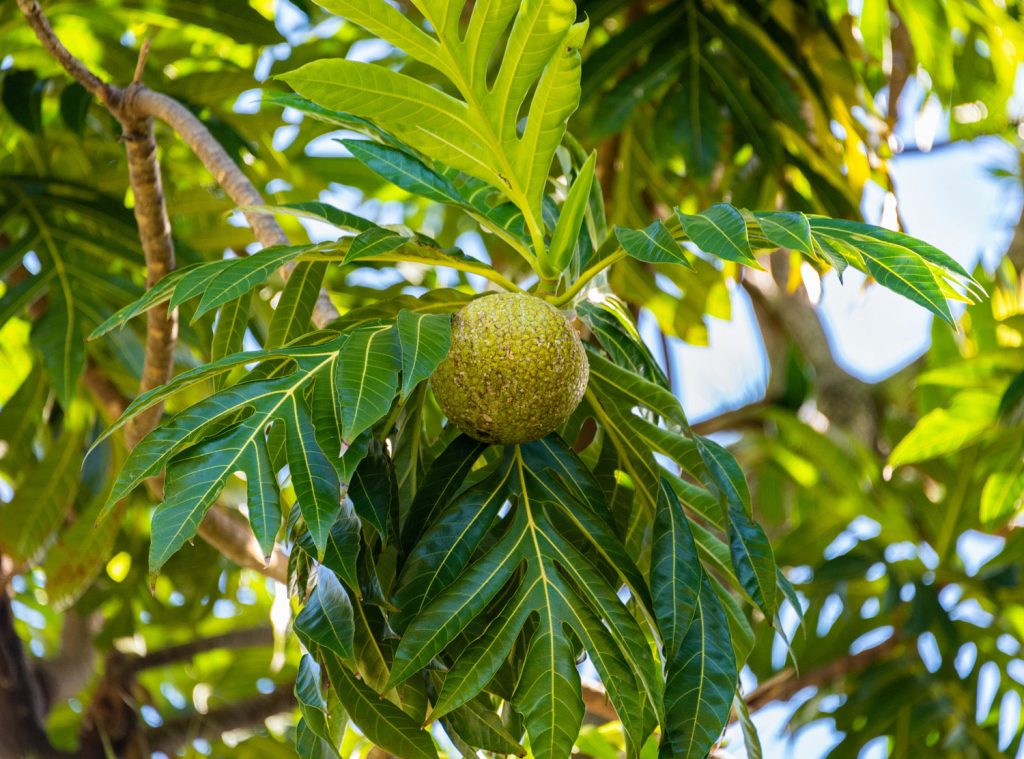
The breadfruit was intended as a local and cheap substitute for imported wheat or rice, ideal in the eyes of the plantation owners for feeding an enslaved workforce
Anderson was a keen researcher and cataloguer, and his 1800 inventory of the garden was 1,000 pages long. In 1785, there were 60 plant species in the collection; by 1806, over 1,300. His extraordinary work has been brought to life in research by the University of Winchester and the St Vincent Botanic Gardens themselves.
Anderson was open to different agricultural practices, and he noted that the European method of neatly weeding and clearing gardens was “ridiculous” in the tropics when compared to the African tradition of vegetable plants crowded together in profusion. The enslaved gardeners brought their understanding of local climate and conditions to Anderson’s burgeoning collection, using local tools such as cutlasses and employing the methods of the slave provision grounds.
Jamaica opened a botanic garden at the southeastern town of Bath in 1779, 14 years after St Vincent, and this created a network of research and experimentation that was linked to Kew Gardens in London (founded in 1759). Experts corresponded and collaborated, and seeds and plants were sent from different territories in the British Empire to see whether they would flourish in the Caribbean or London.
The ackee, nowadays Jamaica’s national fruit and a prized delicacy, arrived in Kew Gardens in 1793, carried from the Caribbean by a certain Captain Bligh — it was officially named Blighia sapida, though it had been known and eaten in West Africa for centuries.
It was William Bligh, whose notoriety was immortalised in the HMS Bounty mutiny of 1789, who was responsible for bringing the breadfruit to St Vincent four years later. Returning to Tahiti after miraculously surviving the celebrated mutiny and its protracted aftermath, Bligh loaded his ship Providence with over 1,000 plants stored in pots below deck.
Of these, 678 survived the journey to the Caribbean from Tahiti. And on 23 January 1793, slaves carried several hundred of the precious sapling breadfruit plants from the port of Kingstown to the botanic garden, where they were quickly transplanted into the fertile soil. Others were taken to Jamaica, and those remaining to Kew.
There were five different cultivars, and these still grow freely in St Vincent, where a sucker in the botanic garden is thought to be a direct descendant of one of Bligh’s saplings.
The breadfruit was intended as a local and cheap substitute for imported wheat or rice, ideal in the eyes of the plantation owners for feeding an enslaved workforce. But the magnificent breadfruit has long outlived its associations with slavery, and roasted breadfruit and fried jackfish is still the national dish of St Vincent & the Grenadines.
It is hard to miss the breadfruit tree there or more widely across the Caribbean: growing to over 80ft with large, glossy leaves, a mature tree can produce up to 200 fruits weighing over 10lbs each; a tree can live for half a century.
After Anderson, Bligh and the breadfruit breakthrough, St Vincent’s botanic garden went into a long decline, to be resurrected in the 1880s when the abolition of slavery and the resurgence in small-scale farming reignited interest in botanic research.
Now the green space designed and curated by a Scottish scientist and tended by enslaved gardeners of African descent is on the cruise ship itinerary and is admired by visitors from around the world. St Vincent’s annual Breadfruit Festival in August, meanwhile, showcases the surprising versatility of the starchy delicacy brought over from Polynesia almost 250 years ago.