
As French Saint Martin celebrates Carnival in February, and Dutch Sint Maarten in April, Melissa Rose Cooper explores how the island’s We Culture museum aims to be a cultural bridge between islands — and between past and present
Growing up in America with Trinidadian parents, Carnival was my connection to home. The sounds of calypso and soca vibrating through the radio along with the stories about “playing mas” helped shape my identity long before I ever boarded a flight to Port of Spain.
As an adult, I’ve spent more than 20 years chasing that feeling across the Caribbean — from Grenada to St Lucia to Jamaica. So, when I visited Sint Maarten — one of the few places in the Caribbean with two carnivals (Trinidad and Tobago being another) — I was particularly fascinated by the We Culture museum. Located in Maho Bay, it is dedicated to preserving the history of Caribbean carnival(s).
“A lot of the younger generation don’t know when you parade on the streets what it actually means … the culture behind it. That’s getting lost,” says Gerald Hart, the founder of We Culture. “I don’t want to see it die.”
Born in Trinidad, which is recognised as the birthplace or epicentre of Caribbean carnival, Hart is no stranger to it. His parents, Lil and Edmund Hart, founded Harts Carnival, one of the most notable mas bands in the country. He learned to make elaborate costumes at an early age, with his designs earning recognition across the world.
As he explains, many Carnival traditions date back to the enslaved resisting — and mocking — colonial authorities. “A lot of the costumes, the Jab Molassie and the Blue Devils, were to scare and put fear into the French.”
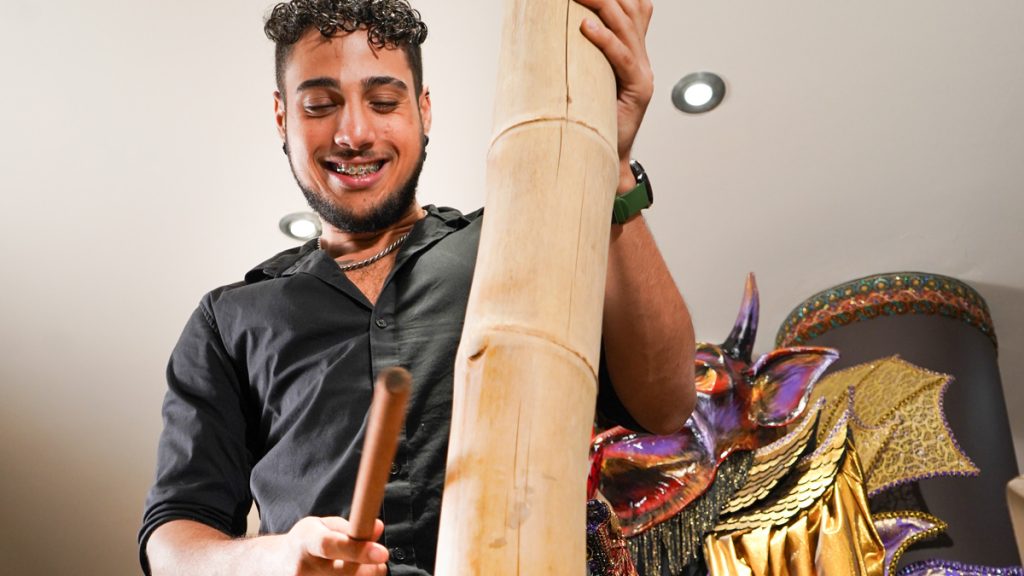
Walking through the museum doors feels like stepping into a Carnival time capsule. Women dressed as traditional characters, like Dame Lorraines, welcome visitors to the sweet sounds of calypso and soca; and several rooms showcase how the festival is celebrated across the Caribbean.
Inside the costume room, characters like the Jab Molassie stand alongside the Pierrot Grenade, while “The Vault” reveals how these vibrant costumes are brought to life. Visitors can explore the design process, and learn about the materials that transform sketches into the stunning creations that light up Carnival stages each year.
Yet, nowhere else in the region does Carnival take on quite the same form as it does in Sint Maarten. “The beauty of it — because of the uniqueness of the island having the northern part French, southern part Dutch — is that we have two carnivals,” says May-Ling Chun, Director of Tourism for Sint Maarten. “The French side’s [comes just before the Christian Lenten season], whereas the Dutch side’s started as a celebration of the Queen’s birthday.”
This year marks 56 years of Carnival in Sint Maarten, and Chun says We Culture’s presence reflects the unity in the island’s diversity. “We have over 130 nationalities, and literally every island of the Caribbean is represented in Sint Maarten.”
That sense of togetherness is especially visible at Festival Village, the central gathering spot during Carnival. “Every person from the Caribbean is usually there. Artists are coming from all over the Caribbean. The food is represented,” says Chun, who adds that the festival acts like a bridge.
Chun describes Carnival on the French side as a more intimate but equally vibrant experience, giving people the chance to witness something truly special. “It’s a melting pot of amazing experiences and that’s why so many people love to come. It’s growing every year,” she says.
And while Carnival’s growth adds to Sint Maarten’s tourism, for Chun, it’s more than an economic driver: it’s a cultural staple — one that We Culture is helping to sustain throughout the year.
“I feel everybody needs to experience it,” she says. “Carnival started for a reason. In every Caribbean island, it’s a little different. But to see how costumes are made or to see even how costumes are represented, or the language, the slang, the dialects … It’s so informative and you get a part of history, heritage, and culture.”
Sint Maarten’s dual identity — half Dutch, half French — mirrors the wider Caribbean experience: islands separated by geography but united by shared traditions. It’s not unusual to hear musical genres like soca and zouk blend effortlessly at beach bars. We Culture captures that connection with its immersive music rooms, where interactive exhibits explore a range of regional musical styles. There’s even a steelpan visitors can play.
Hart’s vision extends far beyond the museum’s walls. He hopes to one day include Caribbean folklore. But, ultimately, Hart wants to preserve Carnival’s cultural roots.
“I think it’s important for people to know that, when you’re enjoying Carnival, it’s because a lot of people sacrificed to make it what it is now. They should know about it — and then have their drinks and party hard, but remember it.”