
Sir Walter Raleigh (1553–1618) was the prototype alpha male. An outstanding figure in the Elizabethan era — an age where the idea of English heroism has been mythologised — he could do anything. By the age of 38 he had played a part in defeating the Spanish Armada, been involved in the colonial settlement of Virginia, helped suppress rebellion in Ireland, and allegedly introduced the potato to England.
He also wrote poetry, popularised tobacco smoking and, in an act of Tudor gallantry, placed his velvet cloak over a muddy puddle so that Queen Elizabeth I would not dirty her feet. (The last is almost certainly untrue.) A loyal Protestant, he was knighted in 1585 and was a favourite at the royal court.
But like a true alpha male, he was prone to overreaching. In 1592, Elizabeth was furious to hear that Raleigh had secretly married one of her ladies-in-waiting without her permission. Perhaps jealous, the volatile queen had him and his new wife imprisoned in the Tower of London. They were released after a couple of months, but Raleigh’s relationship with the queen was seriously damaged. He retreated to his estate in Dorset, eager to find a way back into the royal circle.
In 1594, Raleigh hatched his plan. He had questioned captured Spanish mariners during his expeditions to the Americas and learned of the wealth of Spanish South America. He then came across an account published in Spain of the huge riches supposed to exist in the northeastern region of the subcontinent known then as Guiana (encompassing Venezuela, Guyana, Suriname, French Guiana, and parts of Brazil).
This account told of a wild and largely uncharted land, far from the settled Spanish colonies of Peru and Colombia, and where a fabled city called El Dorado was filled with gold. The Spanish had tried repeatedly and unsuccessfully to locate the lustrous city, a nearby vast lake, and a king who was — so it was said — ceremonially covered in gold dust. But Raleigh was confident that he could rise to the challenge.
Assured of a “gold-rich empire more lucrative than Peru” and keen to deal Catholic Spain a blow, Elizabeth endorsed Raleigh’s planned expedition up the River Orinoco in search of El Dorado. London investors also backed the scheme and, on 6 February 1595, four ships and 100 men left Plymouth on their journey across the Atlantic to the Caribbean.
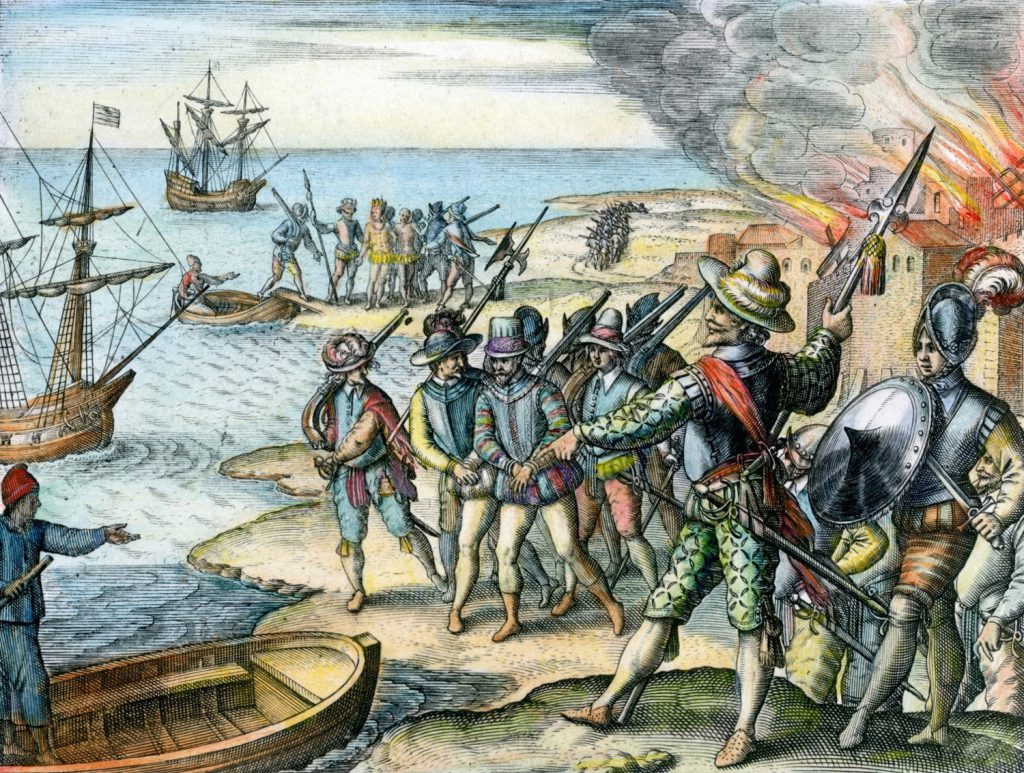
In April, after some exploration, Raleigh landed in the Spanish colony of Trinidad, where he captured the governor, Antonio de Berrio, who had already led expeditions of his own up the Orinoco. What we know of the events that followed mainly comes from Raleigh’s own published story (of which more later), and so should be treated with caution.
It seems probable, though, that his party managed to travel some 300 miles inland from the mouth of the Orinoco, using a cut down ship and flat-bottomed boats to navigate the labyrinth of waterways and dense jungle.
They were attacked by a rival Spanish force in canoes but fought them off, reaching (Venezuela’s) Caroni River, and making contact with an Indigenous tribe whose chief Topiawari told Raleigh of a sophisticated and wealthy people living in the interior’s mountains who had plentiful gold.
The English pressed on as far as Mount Roraima — a vast table-top tepuy — gathering what they hoped were rocks containing gold ore. Running out of supplies and exhausted, the expedition then turned back.
But like a true alpha male, he was prone to overreaching
Remarkably, only one man was lost (eaten by a crocodile), and it was decided to return to England. After destroying the Spanish settlement in Trinidad and plundering the town of Riohacha (in modern Colombia), Raleigh and his expeditionary force reached London in August.
If he expected a hero’s welcome, it was short-lived and lukewarm. Experts declared the rocks brought back to be worthless, and investors were angry. Fearing the reaction of a disappointed queen, Raleigh opted to double down on the claims he had made before leaving and quickly wrote a book he titled The Discovery of the Large, Rich, and Beautiful Empire of Guiana. It was published in 1596, 430 years ago.
The book is not an easy read. It firstly lists earlier Spanish attempts to locate El Dorado — all of which ended in failure — before outlining the perseverance and heroism of the English expedition. Some details are factually accurate — describing rivers, mountains and Indigenous settlements — and Raleigh’s account of his navigation upstream bears witness to his skills.
But the bombastic claims of incalculable wealth had no basis in truth and — to boost sales — he repeated exaggerated claims or invented fantastic stories of men with no heads; with eyes in their shoulders; and of a lush, tropical paradise.
His travel book was certainly not the first or last to embellish the truth, and it was a huge success, perhaps making up in part for his failure to bring back the gold he claimed to have seen.
Raleigh then seems to have turned his attention to other matters — fighting the Spanish at Cadiz, sitting in Parliament, and becoming Governor of Jersey. In 1603, Queen Elizabeth died, and Raleigh’s luck ran out when he was arrested on charges of treason against her successor James I. His life was spared, however, and again he found himself in the Tower of London — this time staying in prison for 13 years, during which time he fathered a son and wrote the modestly titled The History of the World.
However, Raleigh’s adventures in South America were not yet over. In 1616, King James released him — persuaded by his claim that the Indigenous Peoples of Guiana hated the Spanish and had pledged allegiance to the English Crown.
The king ordered a second expedition to the region in search of gold — but this time Raleigh was expressly commanded to avoid conflict with the Spanish, as treaties had been signed with Spain in a bid to end decades of conflict.
The second attempt was a fiasco. Once more, no gold was discovered, but — much worse — Raleigh’s longstanding second-in-command Laurence Kemys attacked and destroyed a Spanish settlement while Raleigh himself was sick with fever at his camp on the island of Trinidad. Raleigh’s son Watt was then killed in fighting with the Spanish, and Kemys died by suicide in disgrace.
As the mission ended in disaster, Raleigh attempted to escape to France but was brought to London, tried for treason and disobeying royal commands, and beheaded at Westminster on 29 October 1618. With typical bravura, he is said to have urged a hesitant executioner to “strike, man, strike!” — drawing to an abrupt end the so-called Golden Age of Elizabethan England.
El Dorado — the city, the lake, the gilded king — was never found, though significant gold deposits have been discovered in Venezuela and Guyana, increasing fears of the environmental impact of unregulated mining. Major deposits are to be found in the Orinoco Mining Arc in Bolívar state.
The Indigenous Topiawari was perhaps not wrong when he directed Raleigh to the mountains of the Guiana Shield, where the fantasy of untold wealth that he concocted in his book might indeed have materialised.