
Jamaica’s capital Kingston is currently undergoing a construction boom. The historic Downtown is being remodelled with the Waterfront extensively reconfigured. Public and private investment is fuelling a building bonanza as crumbling factories, stores, and tenements are refurbished or replaced by new corporate headquarters and apartment blocks.
The more prosperous New Kingston district is also witnessing urban regeneration. But the most spectacular change is Downtown, where the grid layout of offices and warehouses — many abandoned in a long exodus to the suburbs — is facing a full-scale makeover. Even Water Lane has been pedestrianised and enlivened with colourful wall art. Bars and restaurants are beginning to spring up in streets previously considered off-limits to tourists.
Critics fear that the poorer sections of society who live in Downtown may be the victims of gentrification. But the developers are committed, they say, to honouring and preserving inner-city Kingston’s cultural legacy, recognised by UNESCO as a “city of music”.
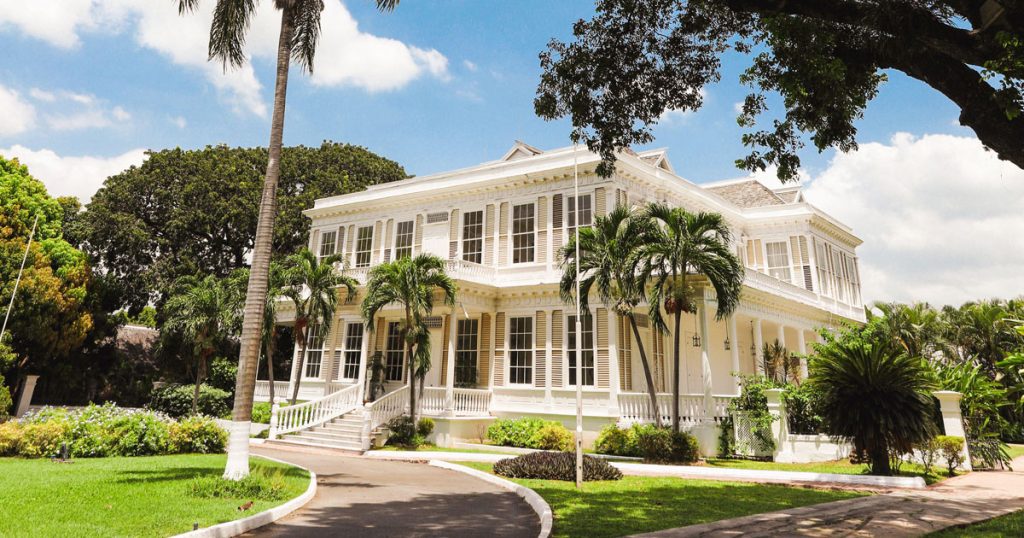
The aspirational buzz of contemporary development stands in contrast to, but also parallels, a much older and venerable architectural survivor in Kingston. Devon House — set in verdant 11-acre grounds complete with lawns and towering royal palms — is a Georgian-style mansion sitting on Hope Road, once an upmarket residential avenue and now a busy and congested thoroughfare.
The house is a fine example of symmetrical classicism, with an elegant wooden façade, porches and hipped roofs. It was completed in 1881, built on the grounds of a former rectory as the residence for George Stiebel, widely known as Jamaica’s first Black millionaire.
Stiebel was born in 1821 and died 130 years ago, in 1896. His story is one of huge wealth, and Devon House is the imposing testimony to his fortune. He managed to accumulate this fortune during a period in Jamaica’s history that was largely dominated by post-slavery poverty and social unrest.
His success has been interpreted as a tribute to his entrepreneurship — a classic rags to riches journey which defied racism, though this version of events has also been contested. In any event, his career was certainly based on financial dynamism and risky investments, which clearly paid off.
Far from being poor, Stiebel was the son of a German Jewish merchant from Frankfurt and his mixed-race housekeeper. Neither a member of the small white elite nor familiar with the lives of the marginalised Black majority, he did not fit in.
He left school at 14 and was apprenticed as a carpenter, but sometime during the 1840s his father was able to give him enough money — allegedly acquired as compensation for three slaves he was obliged to free at Emancipation — to buy a ship. His business was in shipping cargo (and apparently gunrunning in Cuba), and he was able to acquire two more ships for trade between the Caribbean and South America.
Disaster struck in 1856 when his ships were destroyed in a storm and he was nearly drowned — but he survived and still had the resources to back a new venture in the El Callao Gold Mining Company in Venezuela. This was literally a goldmine, and Stiebel made his fortune by investing in the speculative operation in remote El Callao.
Two other shareholders sold their shares cheaply, but Stiebel kept his and invested in modernising the mine, finally hitting the jackpot when significant amounts of gold were found and the company was capitalised at US$16 million. After some 20 years away and now married with two children, he was ready to return to Jamaica as a very wealthy man.
Devon House is a staple of Kingston’s tourist circuit, conveniently close to the Bob Marley Museum
Perhaps unsurprisingly, his good fortune quickly enhanced his social status, especially after he bought a range of properties, including sugar plantations, a wharf at Kingston’s port, and a cattle pen.
The (now) Honourable George Stiebel entered public life on the Board of Education and as Custos (a prominent civic leader) of St Andrew parish. He was able to lend the city fathers a large sum in preparation for the proposed 1891 Jamaica International Exhibition, an event that sparked an earlier building boom in anticipation of foreign visitors.
Stiebel had joined the upper echelons of colonial society, but he was also keen to expand voting rights in the wake of the traumatic 1865 Morant Bay Rebellion, in which some 400 disenfranchised Jamaicans had been killed in anti-poverty rioting. He served on a commission and argued against minimum literacy and property-owning qualifications.
Stiebel’s lasting imprint on Kingston, however, was Devon House, designed by Charles P Lazarus — a local politician, engineer, and foundry owner. Conceived as a symbol of Stiebel’s financial power, it was intended to project opulence with its columns, high-ceilinged reception rooms, and outdoor stables. According to Jonah Rowen in The Avery Review:
The featured interior space is undoubtedly the second-story ballroom, its wall panels in the style of Italianate grotteschi with vases and curling acanthus leaves, and a concave beige cornice adorned with plastered white swags and light-blue figural vignettes reminiscent of Wedgwood manufactures.
Ice was imported from Nova Scotia in order to cool this room during social events. Elsewhere, verandas, louvered windows, and chandeliers created the ambience of an 18th-century plantation house — a deliberately archaic choice.
Devon House was also well built, surviving the great earthquake of January 1907 which destroyed many of Kingston’s older buildings, including those in the original Downtown area. It was joined by two other grand residences on the junction of Hope Road and Trafalgar Road — baptised Millionaires’ Corner.
Today, only Stiebel’s house remains, the others having been demolished by developers. And this is the fate that might have befallen Devon House. After Stiebel’s death, it passed to his daughter, then to Reginald Melhado, and subsequently to the Lindo family of Wray & Nephew rum fame.
In the 1960s, the house became vacant, run down and threatened with demolition. The Jamaican government acquired the property in 1967, intent on preserving a unique example of Jamaican-Georgian architecture in the name of cultural heritage.
Six decades later, after several refurbishments, Devon House is a staple of Kingston’s tourist circuit, conveniently close to the Bob Marley Museum. Critics complain that it is overly commercialised and that expensive guided tours of its interior can deter locals. But the shops, food outlets and grounds seem popular with visitors and residents alike — as does the opportunity to inspect local craftsmanship and restoration in the spacious bedrooms and ballroom.
One cannot help but think that George Stiebel would be pleased with the modern iteration of Devon House. He meant it as a monument to his endeavours, and today it memorialises his remarkable social ascent while unashamedly making money in the process. As Kingston is gradually modernised and remodelled, this imposing building reminds us that aspiration and enterprise are nothing new.