
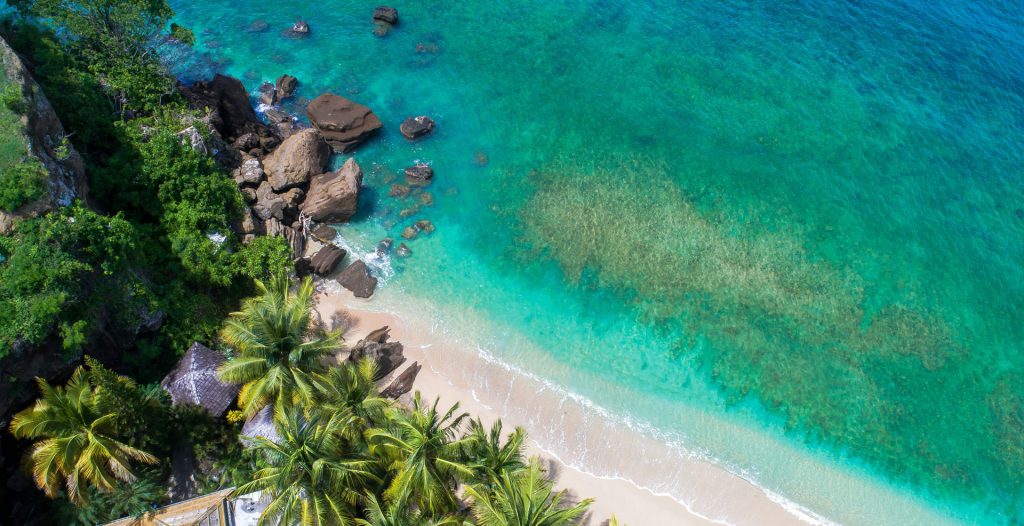
Coconut palms are to the Caribbean what olive trees are to the Mediterranean. It’s almost impossible to imagine the region without them. Not only do they play a central role in tourism by defining our tropical landscape, they’re deeply ingrained in our islands’ cultural identity. The fruit features in everything from cuisine and crafts to beauty products and traditional medicine.
What many visitors so enchanted by the palms’ beauty are unaware of is the rigorous and pioneering work undertaken to protect them from a devastating disease. The trees may not be native to the Caribbean — having been brought here centuries ago by early settlers — but, as far as most people are concerned, they’re as quintessential as Carnival, rum, and breathtaking beaches.
Lethal yellowing has been decimating the region’s iconic palms for decades. It can kill a tree in as little as three months, and swiftly wipe out 90% of a local coconut tree population. Spread by a plant-hopping insect, the epidemic has left a trail of headless trunks in several islands from The Bahamas to Trinidad. Last March, Dominica became the latest to confirm the dreaded disease.
In Jamaica alone, lethal yellowing wiped out nine million trees between the 1950s and the 1990s, says Shaun Cameron, CEO of the country’s Coconut Industry Board (CIB). Keen to protect lucrative exports of copra (coconut meat), the Jamaican government created the CIB’s research department in 1959. Scientists were able to link the disease to a bacterial parasite transferred from tree to tree by a leafhopper.
“Copra used to be a massive export for Jamaica. We would sell it to the United Kingdom and North America to be used for oil, soap, and other products,” Cameron tells Caribbean Beat. “When you think of a tropical island, the first two things that come to mind are a sandy beach and a coconut tree. Palms are an integral part of our heritage and culture.”
Years ago, Jamaican tradition dictated that when a baby was born, the umbilical cord would be buried under a coconut palm to symbolically anchor the child to its roots.
“It’s considered the tree of life and is said to have a lot of medical benefits,” Cameron continues. “Coconut is a staple in food and gives it a particular taste profile, while coconut water is good for natural hydration and was even used as a substitute for blood plasma during World War Two.”
Extensive research carried out by the CIB led to the creation of the Maypan palm, a hybrid of two other palms — the Malayan Dwarf and the Panama Tall — that is highly resistant to lethal yellowing. It was officially launched in 1974.
“We took the best qualities from both trees and made one unique coconut,” Cameron explains. “It has a bigger bowl, more water and a better taste.”
Maypan seedlings have been given to farmers across Jamaica, who have also received special training in how to spot — and mitigate against — lethal yellowing.
“Data last year showed we have an estimated 4.8 million coconut trees in the country,” Cameron says. “We only lost around 1,400, so that is a massive turnaround.”
Today, the trailblazing work sees the resistant nuts exported across the region, along with South Florida which also lost millions of its palms to the disease. Meanwhile, Jamaican experts have been busy sharing their knowledge with their Caribbean counterparts.
In Antigua, where an outbreak destroyed more than half of the island’s coconuts palms a decade ago, the Maypan has been pivotal in restoring the prized seascapes.
“We haven’t fully got rid of lethal yellowing, but it’s under control and continuously monitored,” says the Ministry of Agriculture’s Tyreke Horsford.
Coconuts are a key ingredient in Antiguan cuisine — from tarts and sweetbreads to ducana, a dumpling made of coconut and sweet potato and often eaten with saltfish.
“Traditionally, we used every part of the coconut tree,” Horsford says. “We’d use the husk for rope and fuel, the shell for bowls and crafts, the leaves for weaving, and the fruit for food and drink. Older people remember it as a daily staple; it would be grated by hand, or drunk straight from the shell.”
The palms’ ability to absorb carbon dioxide at higher rates than many other species makes them a valuable weapon against climate change
Vendors selling coconut water can once again be seen lining Antiguan roadsides. But it was an arduous process to get here, recalls Dr Janil Gore-Francis, the country’s Chief Plant Protection Officer.
Several hotels resorted to injecting costly antibiotics into diseased trees in order to preserve their idyllic beachfront scenery. To keep lethal yellowing in remission, such treatment must continue for the plant’s entire life cycle. It also renders the fruit unusable.
The government’s tactic was to remove affected trees, burn them and replace them with resistant varieties like the Maypan and the Malayan Dwarf. And Dr Gore-Francis says some palms have built up a natural resilience of their own.
Robust efforts in St Kitts — where lethal yellowing was confirmed around the same time as Antigua in early 2012 — have also reaped dividends. Former Director of Agriculture Melvin James says the government imported several thousand resilient nuts some years ago, which are now bearing fruit. As a result, the trade in local coconut water is thriving.
“Everyone is drinking it,” James says, adding: “Coconut is also popular with the agro-processors who have infused it into their soaps and other products.”
Still, Antiguan ecologist Kevel Lindsay fears not enough has been done to assess the disease’s impact on the region’s biodiversity.
“Royal palms and other native palms have also been impacted and succumbed to lethal yellowing, although not as aggressively as coconut and the other introduced palms,” he explains.
Coconuts, brought here by Europeans from West Africa and the coasts of the Indian Ocean, are believed to have been planted in the Caribbean since the 1600s. A handy source of hydration and nutrients on the lengthy sea voyages of old, they were sometimes planted around sugar plantations to provide a cheap supply of water and food.
“They were also imported into some islands to help species like parrots,” Lindsay says. “The woodpecker drills a hole into the palm to eat the sap. That hole starts rotting and makes it possible for bats and other small mammals, insects and other birds to chisel out the hole and use it for roosting and nesting. Without palms, the number of potential sites for them to do that diminishes considerably.”
In Dominica, the fight to stem the disease and protect the livelihood of the nature isle’s coconut farmers is only just beginning. Agriculture Minister Roland Royer recently announced plans to compensate impacted growers, along with containment measures to arrest the spread, and the planting of resilient trees.
They would do well to learn from Jamaica. Last year’s Hurricane Melissa destroyed 30% of the CIB’s hybridisation farm in St Elizabeth — but that’s only given Cameron and his team renewed vigour.
“We use every crisis and turn it into an opportunity. So, we are busy replanting, getting nuts from other countries, and adding another set of varieties to the farm so we will have more diversity,” Cameron says.
As the primary coconut research body in the region, the CIB’s work is pivotal to the future of the Caribbean’s most cherished trees. The palms’ ability to absorb carbon dioxide at higher rates than many other species makes them a valuable weapon against climate change.
Cameron hopes the region’s coconut palm orchards will eventually earn revenue in carbon credits.
“As small island developing states, we have a significant responsibility to protect our environment,” he adds: “So this is definitely something I am going to champion.”