
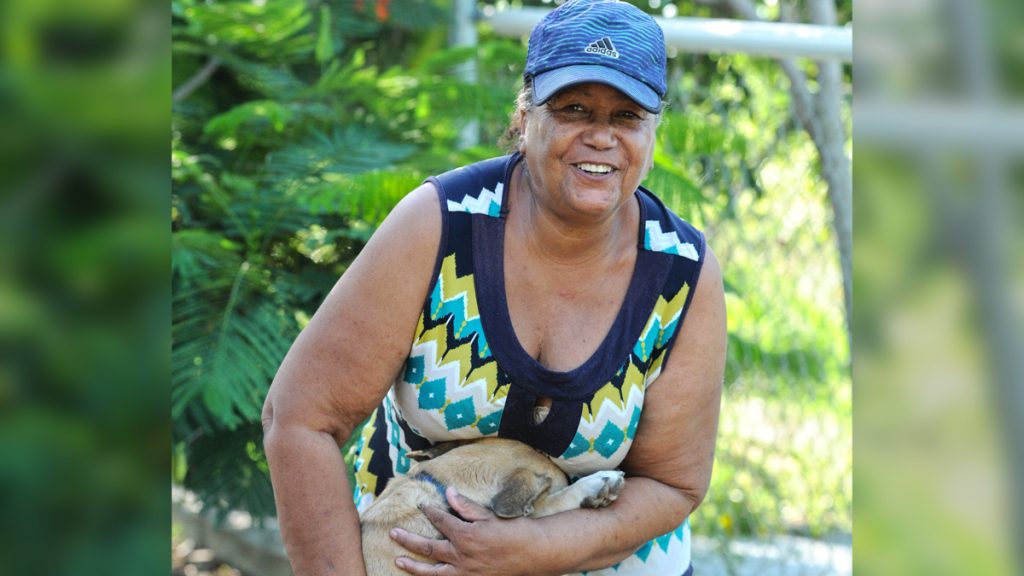
They can detect cancer and changes in blood sugar, sniff out drugs and bombs, and provide emotional support. Yet for all dogs have to offer humans, their loyalty is not always reciprocated. The sight of forlorn-looking canines wandering city streets and rural villages alike, ravaging trash cans and rummaging through bushes on the search for food, is a common one on too many Caribbean islands.
While efforts to help them among a slew of ardent volunteers may be robust, the availability of funds to do so remains limited. And in Antigua & Barbuda, the country’s oldest animal rescue charity closed its doors for good last November after almost 30 years in operation.
Paaws Antigua’s Parham-based shelter once held more than 80 dogs awaiting homes, but when I visited ahead of its closure, it was ominously quiet compared to its heyday when the cacophony of barking would incur complaints from the neighbours.
Alex Brumant sits under the shade of a neem tree, stroking a young female pup who gazes at him with trusting brown eyes. Alex, who first joined the shelter as a kennel worker in 2014 and stayed for several years, returned to help Paaws rehome its final residents as it wound down.
“Sometimes it takes dogs a while to trust you. The secret is being really kind to them — and sometimes it’s food,” he smiles. “Back in the day, a lot of people didn’t know how to deal with dogs. Attitudes have changed a lot over the years; people are starting to realise they can actually be your best friend.”
Born and raised in Antigua, Alex grew up with dogs as pets and counts two of Paaws’ former inhabitants — Coffeebean and Indy — among his family.
Paaws started life in 1996 as an informal foster programme, before opening a purpose-built shelter in 2003. Over the years, it found homes locally for more than 4,000 dogs, running entirely on donations. The coronavirus pandemic precipitated its financial demise, with donations never returning to pre-pandemic levels, and the charity confirmed its impending closure in October, 2024.
Alex’s usual job is with the Antigua Spay & Neuter Clinic — another donation-dependent entity that, rather than rescuing abandoned, sick and abused creatures, tackles the issue of roaming dogs and cats at its roots.
“People are becoming more aware of how animals should be treated”
Many local residents still don’t realise how fast dogs and cats breed, Alex says. The clinic’s crew go door to door across Antigua, offering the procedure to the pets of low-income families at a heavily discounted rate or, in many cases, for free.
“We realised that picking up and homing dogs was only solving half the problem; what we really needed to do was prevent them from being born,” explains the clinic’s president Rachel Wood.
Changing mindsets was initially one of the biggest obstacles. “At first, people either didn’t understand the point of what we were doing or just weren’t interested. Now most of the time I offer, hardly anyone says no,” Rachel says.
The sight of skinny, mangey dogs isn’t just heart-wrenching; it can also threaten the island’s economic mainstay by deterring tourists from returning. The clinic has “fixed” around 6,000 animals since it was established in late 2016. And the result? “Repeat visitors to Antigua tell me they notice a difference on the streets,” Rachel says.
Princess Simone Donelan manages what is today the island’s largest shelter — The Sanctuary — run by another charity, Dogs & Cats of Antigua. The Trinidadian-born animal lover was visiting relatives in Antigua last Easter when, after spotting several strays island-wide, she called the organisation’s founder Joy Farrell to offer her help.
What was intended to be a temporary trip turned into an indefinite one with Simone eventually bringing her 18-year-old dog Soldier to Antigua too. While her current role might not be as glamorous as her former career in film production back home, Simone says it’s eminently “fulfilling”.
The Sanctuary is presently caring for 120 dogs at its Osbourn facility and is feeding around 90 more each day through its community outreach programme. “It’s not an easy job and there’s always some heartbreak,” she admits. “But I do feel we are making a difference.”
There’s one dog in particular that has left a lasting impact. “Whisper was found in a drain and brought to The Sanctuary. She was having constant seizures, and we were advised to put her down. But I stayed with her all night, giving her electrolytes, and she slowly recovered. Now she’s the most beautiful dog and greets everyone who enters the shelter with a full body hug,” Simone beams.
“Dogs are sentient beings and sometimes we have to give them a chance. Caribbean pot-hounds are the most loyal dogs, resilient from being on the streets, and they remember. I know Whisper remembers the night I spent with her, and we have a special bond,” she says.
For their part, Antigua’s tourism officials have acknowledged the problem of roaming dogs and pledged their support to local charities. That can’t come soon enough for Joy Farrell. January marks the 11th anniversary for the nonprofit, which has successfully rehomed 6,000 dogs overseas by forging links with animal charities in North America.
Still, it’s an uphill battle to raise the thousands of dollars The Sanctuary needs to survive. Food bills alone can reach US$5,600 a month, Joy says.
To complement the shelter’s five paid staff, the group boasts an ever-expanding network of around 40 volunteers. “People are becoming more aware of how animals should be treated,” Joy explains. “They’re more inclined to report animals in trouble now, more concerned for their welfare, and more interested in helping.”
As for Paaws, its volunteers will also continue to advocate for the nation’s four-legged friends, says the charity’s trustee and long-time supporter Rachel Fuller Townshend. “It’s sad that we have reached the point of closure,” she adds, “but it’s now time to focus on solutions-based initiatives like the Spay & Neuter Clinic.”
Happily for Antigua’s animals, these days there are other groups which can carry the mantle. And for those like Simone, it’s a special kind of work. “You don’t go into this job to get rich,” Simone adds. “It’s a soulful richness instead.”