
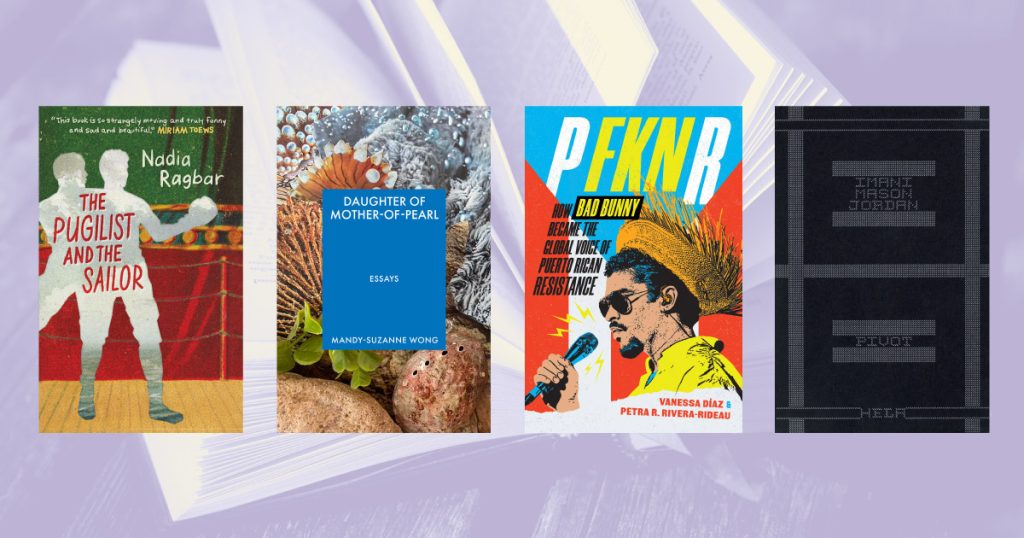
This month’s reading picks from the Caribbean, with reviews by Shivanee Ramlochan of The Pugilist and the Sailor by Nadia Ragbar; Daughter of Mother-of-Pearl by Mandy-Suzanne Wong; P FKN R: How Bad Bunny Became the Global Voice of Puerto Rican Resistance by Vanessa Díaz and Petra R Rivera-Rideau; and PIVOT by Imani Mason Jordan
The Pugilist and the Sailor
by Nadia Ragbar (Invisible Publishing, 300 pp, ISBN 9781778430718)
You love your brother? Try sharing a limb with him. In one of the most tender and affecting debut novels you’re likely to read this year, The Pugilist and the Sailor delves into the lives of a pair of 30-something-year-old conjoined Torontonian twins. Guyanese-Canadian Ragbar pulls off something so convincing and exquisitely-judged in her portrayals of boxing aficionado Dougie and stoic, would-be seafarer Bruce that it’s disappointing to concede they aren’t actual people. The novel itself is an accomplished study in dissecting parallel, yoked lives, and of the pressures of self-perception when one exists, always, within the arm span of a nigh-unbearable intimacy. During shadow boxing, “in each of the twins’ secret hearts, separate impulses were percolating as they punched combinations at their reflections.” It would be impossible not to be moved, profoundly altered even, by this beautifully — necessarily — strange story.
Daughter of Mother-of-Pearl
by Mandy-Suzanne Wong (Graywolf Press, 168 pp, ISBN 9781644453735)
What do we do for the smallest among us? To think only of our humanity, Daughter of Mother-of-Pearl advocates, is to cruelly stunt our own empathetic powers, our responsibilities. This slender yet content-rich volume of essays by the Bermudian Wong meets multiple invertebrates at their level — from cuttlefishes to sea urchins, squids to starfishes. In every encounter with nonhuman life, the author’s focus is total, starry with devotion, decked out in scientific nomenclature so specific it feels like its own love language. Even the most hard-eyed “Humans Only!” fort-keepers must lower their ramparts for these speculative nonfictions, which, in imagining the interior intelligences of these creatures, do more than humanise them — they give them their own lives in textual abundance, in narrative splendour. Every part of this book astonishes. Each essay reveals how we might do better by the evanescing world we claim to caretake.
P FKN R: How Bad Bunny Became the Global Voice of Puerto Rican Resistance
by Vanessa Díaz and Petra R Rivera-Rideau (Duke University Press, 320 pp, ISBN 9781478033332)
Benito Antonio Martínez Ocasio, aka Bad Bunny, has catapulted beyond household fame: he’s a global sensation. As P FKN R, the provocatively-titled book of essays by academics and scholars Díaz and Rivera-Rideau affirms, Bunny’s Puerto Rican-ness isn’t incidental to his success: it’s embedded in his musical and storytelling bedrock. This gratifyingly accessible work is far more than a cursory biographical drive-by of the megastar’s life and accomplishments. Whether the co-authors are examining Bunny’s LGBTQIA+ acts of affirmation, or his insistence to sing not only in Spanish slang, but specifically Puerto Rican slang, their perspectives feel fresh and fiercely articulated. Bunny’s politics and urgent exhortations for a better, safer, freer Puerto Rico are never far from the analysis P FKN R puts forth, either — this book is a living, joyous syllabus writ large.
PIVOT
by Imani Mason Jordan (HELA Press, 216 pp, ISBN 9781917913065)
“the psyche curls the / throat, somewhere beneath fire”: a book-length poem that reads as compressed resistance and reframing, PIVOT calibrates its expressions — at once fluid and enraged — through the nexus of the Haitian Revolution. Across the poem’s four movements, British author Mason Jordan pursues our understandings of slavery, marronage, uprising, and rebellion, deepening and inculcating them in the rhythmic insistences the poem makes. Dispense with binary readings of this text and feel it open further to you: it is a work that has accumulated life before you even open its first page. PIVOT will reward your attention, and entrust the most attuned reader to a power of knowing that runs marrow deep, in which the poem’s speaker builds “a language of / absurdity, glissant, been tears, between / 18th, the 19th, between marseille / between bourdeux, fanon, rocks, and / continuous frame, no monolithic language”.