
[ad_1]
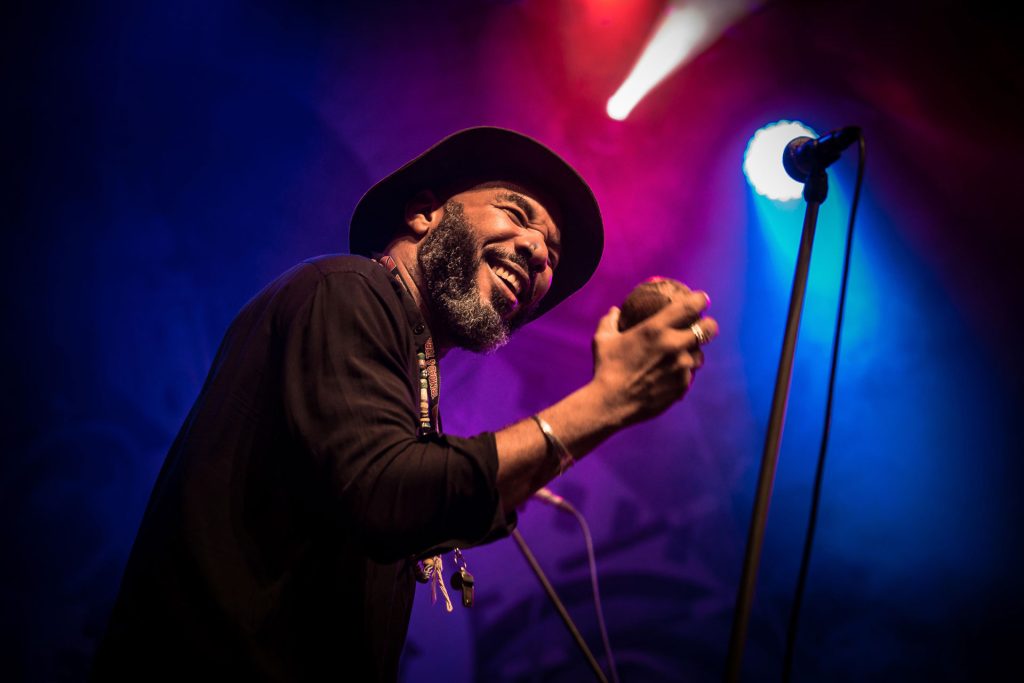
Anthony Joseph stands as a unique musical artist in the regional space: an internationally recognised poet who records albums of music that throb with the cadence and rhythm of the African diaspora. With a two-decade recording career, his distinctive voice is gaining prestige in music festival spaces in Europe and North America, while his words are becoming more important to the understanding of Caribbean characters, culture, and histories. Moving freely from dance music to dub, jazz and neo-soul, calypso and rapso riddims, Joseph’s words are a perfect complement to the myriad sounds of the diaspora.
A major poetic voice in the Caribbean and United Kingdom — winner of the prestigious TS Eliot Prize (2022) and 2023 OCM Bocas Prize for Caribbean Literature in poetry (both for Sonnets for Albert), and a 2023 Fellow of the Royal Society of Literature, among other awards and fellowships — he moves above the austere atmosphere of the English poetic tradition by telling the stories of Afro-Caribbean lives, memories, and episodes, enhanced by music that seeks a global ear.
His poetry has been described as “a fluid experimentation with poetic form, vernacular and cadence and a propensity and style all of his own”; and his words juxtapose neatly with the music — adding a sense of earnestness, elan, and eclectic enlightenment.
An apt definition of Joseph would be a Creole griot. If Trinidad’s rapso music is “de power of de word in the riddim of de word”, Joseph’s oeuvre is rapso elevated.
Born in Trinidad in November 1966, Joseph migrated to England in 1989 and began his publishing career in 1994. “When I first came to the UK, I started a rock band called Zedd, and we did that for a few years,” he says. “I was really interested in Black rock music, like Jimi Hendrix, Living Colour, Bad Brains. And then that fell apart. I got out of music — that was about 1993 — and started really focussing on poetry, and just built from there.”
His poetry would be described in time as “an experimental work of metafiction, myth and science fiction; an ‘afropsychadelicnoir’.”
At that time, he also began dipping his toes into the exciting music melting pot of freeform Afro-Caribbean funk, UK dance music, acid jazz experiments, and the redefinitions of British jazz that second-generation descendants of Windrush immigrants were making.
By 2006, he formed the Spasm Band to support his new musical ideas. The band’s origins lie in his 2006 novel The African Origins of UFOs — “a band on the planet Kunu Supia that play authentic ‘wild island jazz’ … ‘naked island funk’.”
“I think that one of the roles and responsibilities of a Caribbean artist is to become the storytellers, the keepers of the secrets and the history”
With this new band, Joseph rapidly expanded his music releases, which soon outmatched his publishing catalogue. Four consecutive releases — Spirit Lash (2006); Leggo De Lion (2007); La Diablesse (2008); and Bird Head Son (2009) — established Anthony Joseph & the Spasm Band as provocateurs in the UK and Europe’s psychedelic music space, one which acknowledged innovation beyond the colour of one’s skin. French record label Heavenly Sweetness established an early partnership with Joseph that still exists today, releasing most of his recordings.
European critics were having a field day, with his output being described as a “gloriously rewarding volume of spiritual tales … where the parables, pitfalls, redemption and affirmation of life are rapped-chanted-sung-slam-stitched together with Voodoo funk, Rastafarian revelation, bayou blues, calypso rhythms and unbridled free jazz movement.”
Some were also seeing the connections to his performance poetry antecedents: “spoken word lyrics, inspired horns and layered grooves conjure up some sacred syncretic dreams, evoking fabled free spirits like Gil Scott-Heron or The Last Poets.”
Joseph has acknowledged the importance of those pioneers, along with Jamaican dub poets Linton Kwesi Johnson and Mutabaruka, and Trinidadian rapso innovator Brother Resistance. But he notes that “they weren’t there when I was learning to write or where I was learning what my voice was — they came much later. I don’t know if they were influencers in the sense that they were not people that I directly tried to copy.”
He further notes that, “I was influenced, as a writer and as a poet, by people like [Derek] Walcott, [Kamau] Brathwaite, people like the Mighty Sparrow, Lord Kitchener, people like my grandmother, my father who was an amazing orator, people like the Baptist preachers in the churches that we would go to — they had a huge influence on me in terms of using the power of the word, and using it to have an emotional effect on people. If you don’t have a foundation, going towards people like Linton and people like that, you’ll end up just being another clone of them.”
In the 2010s, Joseph completed one more album — a live recording with his Spasm Band in Germany — before evolving his solo brand and broadening his collaborations with a new album in 2013, Time, produced by American neo-soul pioneer Meshell Ndegeocello.
After featuring on a pair of albums (2014–2015) by European acts (BRZZVLL from Belgium and Adam Pierończyk from Poland), Joseph released three significant albums — Caribbean Roots (2016); People of the Sun (2018); and The Rich Are Only Defeated When Running For Their Lives (2021) — that utilised a bold and funky amalgam of British jazz and Caribbean rhythms to capture island aesthetics and memories. (All were reviewed in Caribbean Beat.)
His new band for these three albums, featuring important new British jazz heroes — Jason Yarde, Shabaka Hutchings, Andrew John, et al — “give the music here more urgency than a Congo Square memory, more variety than the blues, altogether reframing Joseph’s words beyond the ‘bluesology’ of Gil Scott-Heron and the dub poetry of Linton Kwesi Johnson.”
On his latest album — Rowing Up the River to Get Our Names Back, released in February 2025 — Joseph says, “I’ve always wanted to make a kind of a psychedelic album that was quite trippy and had a groove. I wanted to do something that was Afrofuturist.”
He further notes that “Afrofuturism uses the future as a tool and a mechanism for looking at the past, and correcting the wrongs of the past: slavery, colonialism, poverty, whatever it might be that Black folks have suffered through. The songs on this album are using sort of forward thinking — either music or ideas — as a way of connecting history and looking at history in a fresh way.”
New producer Dave Okumu, with his “spiritual kind of electronic vibe”, has cooked up a broad palate of modern African and “Afro-diasporaen” music — from Afrobeat à la Fela Kuti to Caribbean funk and dub — to guide the stories here. They celebrate cultures, history, and time.
“Black History” narrates a Caribbean family life over generations — Mister Clarence, Tanty Ursula, Aunt Zeen, Ma Nobelta, and Ma Maria — with fine-detailed descriptions of place and space to add context: “One turntable was all DJ Champ had. The fade was to wait. Two big speaker box for the boom. Two tweeters hung like bees on wire above the front door.”
“I draw on a lot of nostalgia, and from family and heritage,” Joseph notes. “I think these things are important to me. I think that as a Caribbean poet, the fact that I left Trinidad when I was in my early 20s meant that I had a full life there, so those memories could probably last me forever. So what happens is that a lot of that iconography is then filtered through anything I write, and the memories influence everything I write.
“I draw on my childhood and my family quite a lot,” he continues, “but I use them as archetypes and icons for other things. I think that one of the roles and responsibilities of a Caribbean artist is to become the storytellers, the keepers of the secrets and the history.”
Anthony Joseph stands as a leader in a renaissance of spoken word with music, performance poetry on record. His movement to the top of a regional and international cohort of performance poets is notable in its broad use of Caribbean sounds, ideas, and aesthetics. His musical body of work serves as a template for a new way of seeing the Caribbean — past and future.
[ad_2]
Source link