
[ad_1]
Only one face is as omnipresent in Venezuela’s hectic capital Caracas as that of Comandante Hugo Chávez, and it belongs to Simón Bolívar — aka The Liberator. Wearing immaculate dress uniform, his angular features framed by long sideburns, he looks out rather aloofly from thousands of graffiti artworks, often side by side with Chávez and Che Guevara.
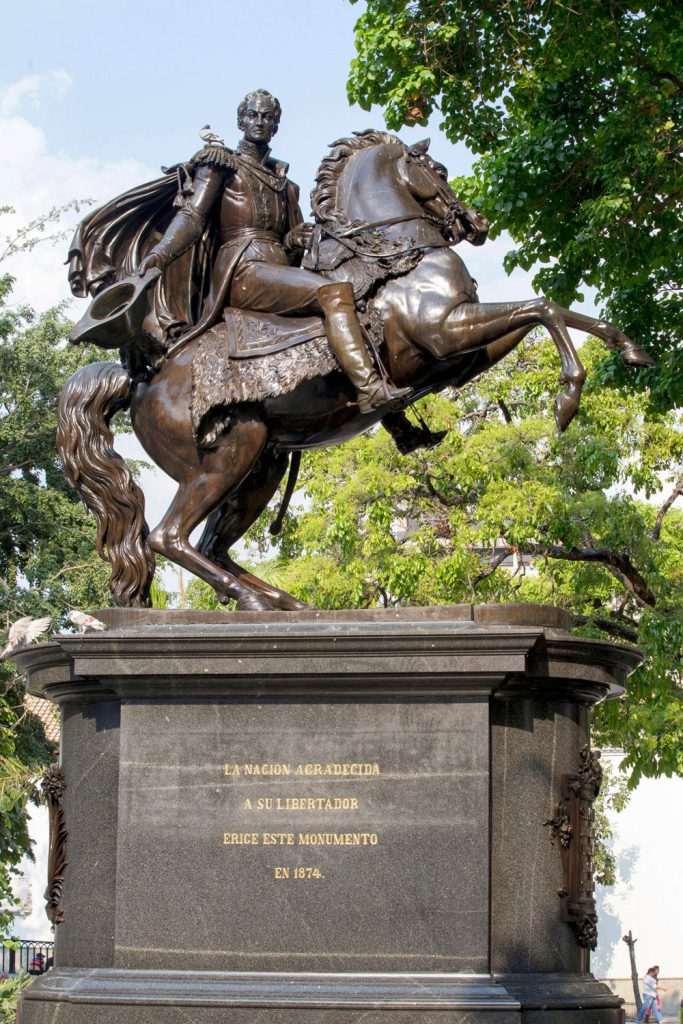
These are the patron saints of the Venezuelan state. An impressive equestrian statue of Bolívar rears up in the city’s main square — named after the heroic horseman — and, fittingly, the country itself is officially titled the Bolivarian Republic of Venezuela. Bolívar, like Chávez, is truly iconic in modern Venezuela, where the currency bears his name. He personifies an ideal of patriotism and lends historical weight to modern national identity.
The cult extends beyond Venezuela — to Colombia, Peru, Ecuador, Bolivia (again named in his honour), and to Panama, all of which claim allegiance to his legacy. All were created out of the independence wars against Spain — a series of conflicts that are inseparable from the figure of Simón Bolívar.
The liberation of four Spanish colonial territories and founding of Venezuela, Peru, Colombia, and Ecuador between 1819 and 1824, and the establishment of Bolivia in 1825, took place under his aegis — transforming Latin America.
Bolívar’s biography is a dizzying succession of military campaigns, victories and setbacks, alliances and betrayals, which lasted some 20 years until his death in 1830. He was a general and statesman, a president and dictator, an accomplished propagandist and strategist.
His ideal was an independent and united Latin America — free of foreign colonialism, ruled through a system of liberal democracy. His opponents were the forces of imperial Spain, as well as politicians and powerbrokers who were loyal to the Spanish king or to their own ambitions.
Much of this story is well documented, but an episode which began 210 years ago, in 1815, remains less known — and it reveals a distinctly Caribbean influence in the life of The Liberator.
On 14 May that year, the 31-year-old Bolívar arrived in Kingston, Jamaica — having chosen temporary exile after a series of military defeats by Spanish troops and local royalists. The first independent republics had been short-lived; he was escaping chaotic infighting, and was exhausted, disillusioned, and short of money.
He found accommodation in a hotel at 33 Princess Street, not far from today’s Downtown Market, but that building has long since disappeared. Nor is much known about Bolívar’s seven-month stay in the colony of Jamaica — other than that he narrowly escaped an assassination attempt, allegedly organised by a Spanish agent.
Haiti’s President Pétion made it clear that no
help would be forthcoming unless Bolívar undertook to abolish slavery on the mainland
He did, however, correspond extensively, seeking backing for the cause of Latin American independence among officials and merchants. He had chosen Jamaica as a place of refuge because he assumed that the British were opposed to the Spanish colonial regime and would support independent countries that welcomed trade with Britain.
But it was not to be. According to the historian Bradford Burns, “the Liberator found only cold politeness”, as London had reached an agreement with Madrid in opposition to Napoleonic France and was tactically neutral regarding the conflict in Latin America. His famous Carta de Jamaica (Jamaica Letter) — a lengthy tract in support of independence — was addressed to one Henry Cullen, a merchant, but was ignored by the British authorities.
The Letter, dated 6 September 1815, is in hindsight viewed as a vital manifesto of Bolívar’s political aspirations. It outlines the cruelty of Spanish colonialism, and projects a future model of a single great nation (Gran Colombia) to be born out of the South American colonies and governed as a cross between a parliamentary monarchy and a representative republic.
Empty-handed and disappointed, Bolívar left Jamaica, arriving on 24 December 1815 at the southern Haitian port of Les Cayes, where eight days later he met Alexandre Pétion, President of the Republic of Haiti. Independent for only 11 years, Haiti was divided between Pétion’s southern republic and the northern kingdom of Henri Christophe.
Pétion, a former general and freedom fighter, immediately supported Bolívar’s anti-Spanish campaign and pledged arms and men to assist in the insurgency. Where the British avoided taking sides, revolutionary Haiti — the only independent republic in the western hemisphere other than the pro-slavery United States — was eager to back the emergence of an independent South America, and thereby gain regional allies.
But there was an important proviso: Pétion made it clear that no help would be forthcoming unless Bolívar undertook to abolish slavery on the mainland. “How can you found a republic where slavery exists?” asked Pétion.
African slavery had been introduced in the Spanish mainland colonies, although it was much less prevalent than in the Caribbean, and Bolívar himself — born into a wealthy colonial family — had inherited plantations and enslaved people.
But he realised that slavery was incompatible with the democratic future he wished to advance, and he agreed to the Haitian condition. President Pétion duly sent an order to General Marion:
Port-Au-Prince, January 26, 1816, the 13th year of Independence. For reasons that I cannot commit to paper, my dear general, but to greatly strengthen the Republic, I command you to make available to General Bolívar two thousand muskets and bayonets … The destination will be given by General Bolívar once he is on board.
Reinforced with Haitian volunteers and Republican exiles, Bolívar sailed for Margarita Island on 31 March and then mainland Venezuela, where he decreed the abolition of slavery. His progress was soon halted, though, and in early September he again sought refuge in Haiti, where Pétion remained supportive.
On 31 March, 1816, he once more sailed for Venezuela, accompanied by Haitian troops. “This group of Haitians that faced down 10,000 European tyrants numbered 300 men,” he later wrote.
Now the impetus was on Bolívar’s side, and despite continued setbacks, his victories outnumbered defeats. On 15 February, 1819, he convened the Congress of Angostura, which created the new Republic of Colombia with Bolívar as its president. “Slavery is the daughter of darkness: an ignorant people is a blind instrument of its own destruction,” he proclaimed.
Yet the issue of slavery — and more generally, racism — was far from settled. The new rulers of Colombia and the other independent states were unwilling to free all slaves immediately, and abolition took years to be completed.
Bolívar himself, who ultimately became disillusioned with the independence he had helped create, was fearful of what was known as pardocracia — rule by the mixed-race majority. His elite background perhaps set limits as to what he considered to be democracy, and critics have viewed him as too cautious in promoting true equality.
Bolívar did, however, honour his pledge to abolish slavery, albeit gradually, and he is held in high esteem in today’s Caribbean. Perhaps ironically, given his impasse in Jamaica, his heritage is more evident in Kingston than in Port-au-Prince. In 2015, two centuries after his sojourn there, the Simón Bolívar Cultural Centre opened in the downtown area, not far from where he was almost murdered. Funded largely by Venezuela, it offers resources aimed at strengthening ties between Latin America and the Caribbean.
[ad_2]
Source link