
[ad_1]
While Tobago’s scenic beaches and lush flora may draw you in with their picture postcard perfection, dig a little deeper and this quietly majestic island begins to whisper its layered stories through aged stone walls, moss-covered gravestones, and towering church steeples. Here, chronicles of times gone by present themselves in subtle ways … just waiting to be discovered.
Assembly Legislature House
Jerningham Street, Upper Scarborough
Exactly 200 years of history echo through the stone corridors of the Assembly Legislature House in Tobago’s capital of Scarborough. Built under British rule between 1821 and 1825, it housed the island’s legislature and judiciary until the abolishment of representative government in 1877. For over a century, the house lost its lustre and stature. But in the early 1980s, it was restored to its original glory, becoming the seat of the Tobago House of Assembly in 1985. Today, this near-perfect example of Georgian architecture stands as a symbol of Tobago’s political evolution — once the foundation of colonial oversight, its chambers now host decisions and debates among elected Tobagonians that shape the island’s future.
Fort King George Heritage Park
84 Fort Street, Scarborough
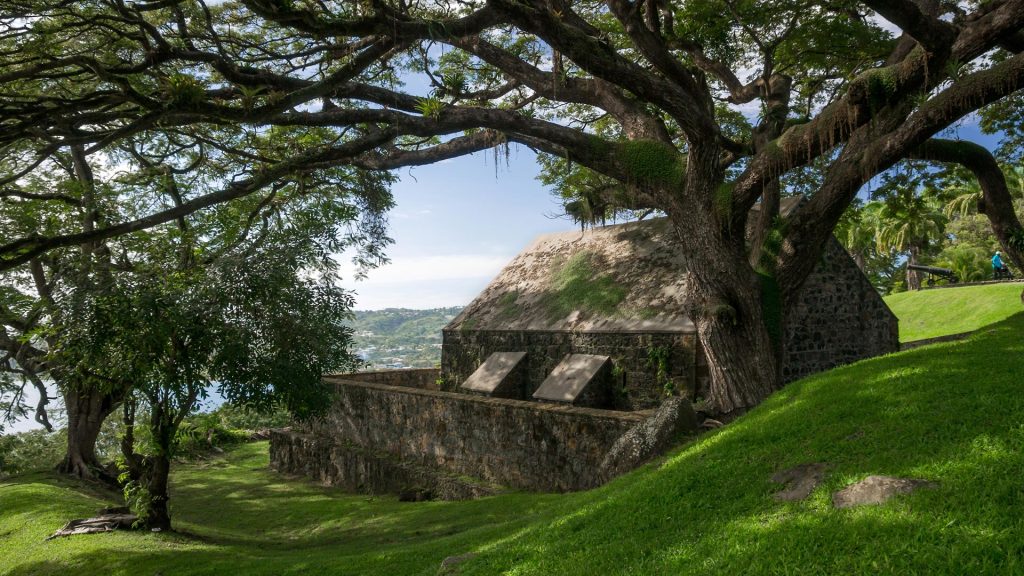
Perched high above the Atlantic Ocean with a bird’s-eye view of Scarborough, Fort King George Heritage Park is Tobago’s most iconic military relic. Originally constructed by the British in the 1770s, the fort served as a deterrent to rival European powers. Its strategic placement is no coincidence, as Tobago’s colonial history is marked by repeated handovers among the French, Dutch, and British for over two centuries. Dubbed “Scarborough Hill” in its first incarnation, it was subsequently named after King George III in 1803. Today, its cannon, officers’ barracks, gunpowder magazine, and jail cells are among the best preserved in the region. The fort is also home to the Tobago Museum, containing artefacts ranging from Amerindian settlements to post-emancipation Tobago, making it a must-visit — not just for the views, but for the deep history it holds.
Courland Monument
Commissioner Street, Plymouth
On the southwestern side of the island, in the village of Plymouth, lies the Courland Monument — a quiet but significant site that commemorates Tobago’s unlikely connection to Latvia. In 1654, the Duchy of Courland (a now-defunct Baltic state) attempted to colonise Tobago, establishing what was then called New Courland. Though the settlement was short-lived and repeatedly contested by other European powers, the Courlanders left a lasting impact. At its peak, Europeans, First Peoples, and Gambians from Africa formed an international settlement of free men at Great Courland Bay, engaging in trade with communities in North America, Brazil, Europe, and Africa. This unique monument, unveiled in 1978, marks the location of that lesser-known, early European foothold. Understated in its design, the Courland Monument serves as a reminder of the island’s often-overlooked ties to minor colonial players and symbolises the many layers — and the international interests — that have shaped Tobago’s past.
Mystery Tombstone
Shelbourne Street, Plymouth
Tobago is a land of stories, and some of them remain unsolved mysteries. One of its most famous enigmas lies in Plymouth — a tombstone whose riddle has puzzled visitors and scholars for over two centuries. The so-called Mystery Tombstone reads: “She was a mother without knowing it, and a wife without letting her husband know it, except by her kind indulgence to him.” The inscription, both cryptic and poetic, adorns the grave of one Betty Stiven, who died in 1783. Historians have speculated about her story, hinting at issues of illegitimacy, secrecy, and colonial-era scandal. But the truth will forever remain buried with her. Over time, this roadside tombstone has become a pilgrimage site — a quiet place where tourists pause, ponder, and confront the complicated realities of human lives lived long ago.
St Patrick’s Anglican Church
St Patrick’s Church Road, Mt Pleasant
Set just off the main road in Mt Pleasant, St Patrick’s Anglican Church is both a place of worship and a monument to endurance. On record as the oldest church in Tobago, it was originally constructed in the early 1800s and served a growing Anglican community during a period of British colonisation and plantation prosperity. Its clean lines, high ceilings, and arched windows are classic Caribbean adaptations of Georgian ecclesiastical architecture. But perhaps its most poignant feature is its steeple — once used as a guide for sailors and fishermen, guiding them safely to shore at Mt Irvine Bay and Little Courland Bay. Since it was first erected, the church has withstood natural disasters and shifting demographics, standing as a spiritual anchor and a guardian of Tobago’s colonial and religious history.
Speyside Estate Ruins & Waterwheel
Windward Road, Speyside
Over on the island’s northeastern coast, the village of Speyside holds one of Tobago’s most evocative plantation relics — the Speyside Estate Ruins. Once a sprawling sugar estate, the site is now defined by a massive, rusting, cast-iron waterwheel that is still as commanding a structure as the day it was installed. Built in the 1800s, the wheel harnessed hydropower from nearby streams to crush sugar cane, a brutal business that depended on the labour of enslaved Africans. Walking among the moss-covered stones and vine-strangled columns — against a scenic ocean backdrop, no less — one can almost forget the turmoil of the times. Almost. It’s a beautiful yet sobering site with nature reclaiming industry, while history stubbornly (and rightfully) refuses to be forgotten.
Tobago’s historical sites do more than preserve stone and mortar — they preserve emotion, legacy, and identity. Whether majestic or humble, marked by grandeur or quiet defiance, these places offer visitors a deeper, more textured understanding of the island beyond its beaches. They invite us to slow down, listen, and remember. Because here, the past doesn’t just rest in books or museums — it lives on, in open air, under sun and rain, for all who choose to walk its path.
[ad_2]
Source link