
[ad_1]
Jonathan Ali talks to the Surinamese-Maroon and Dutch artists behind Monikondee (Money Land)
The Maroni River forms the border between Suriname and French Guiana. For centuries, the area has been home to communities of Indigenous people and Maroons (descendants of Africans who freed themselves from Dutch enslavement). In recent times, however, their traditional ways have come under threat. Gold mining poisons their waterways; climate change has brought both flooding and drought that threaten their crops. Increasingly, a capitalistic way of life imperils their existence.
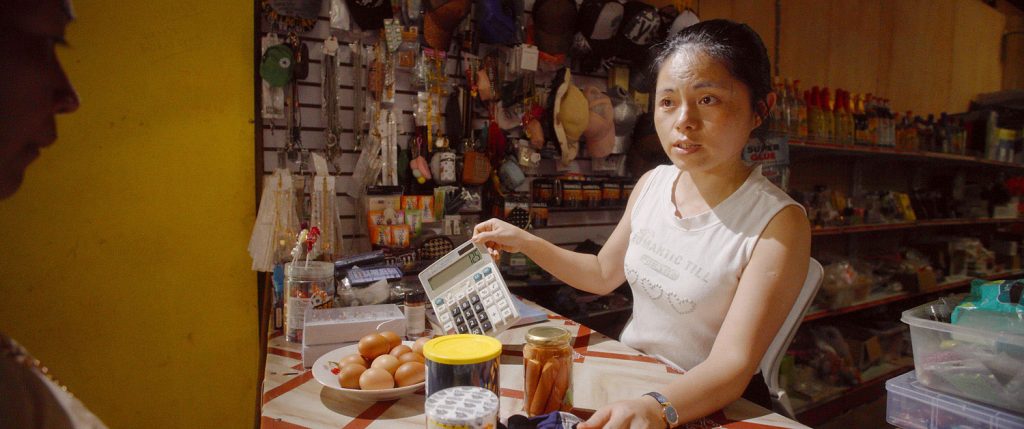
Through stories, songs, and rituals, Monikondee (Money Land) presents the challenges these communities face. At the film’s centre is the boatman Boogie, a Fiiman (“free man”), who plies the forest’s waterways in his motorised dugout canoe, bringing supplies to the villages — but also to the gold miners, making him complicit in the erosion of the way of life of his people.
The second film made by Maroon theatre artist Tolin Erwin Alexander and the Dutch filmmakers Lonnie van Brummelen and Siebren de Haan, Monikondee is a beautifully moving evocation of a people’s struggle to both survive and maintain their proud heritage. They spoke with Jonathan Ali about their collaborative method of working and the hybrid form of documentary and fiction they use in their films.
This is the second film the three of you have made together, following Stones Have Laws (2018). What brought you together in the first place?
SIEBREN: Lonnie and I have been working together as an artist duo since 2002. Over time, we came to see film as a medium for encounter and exchange. Participation and co-creation became guiding principles for our artistic practice, shaping the way we approach filmmaking: not as outsiders documenting from a distance, but as collaborators alongside those whose experiences we aim to share.
LONNIE: The desire to make a film in Suriname arose from our unease with the cognitive dissonance in our country regarding its colonial past. We live in Amsterdam, a city that was a principal shareholder in the Society of Suriname — a company founded to exploit the colony. Dutch colonial rule in Suriname has left its mark on the Netherlands, yet we Dutch remain strikingly ignorant of the country and the shared history that connects us.
TOLIN: I met Lonnie and Siebren by chance in 2015. They told me about their mission and showed me their previous film. In turn, I showed them a theatre play I had recently made with young people. I was drawn to their way of working. We made the film Stones Have Laws with village communities, each of us drawing on our previous experiences but, above all, being willing to create the story collaboratively with the people themselves.
Could you say something about your process? How did you all go from research, to writing, to filming?
TOLIN: We began the project with a research journey along the Maroni River and its tributaries. Before travelling, we informed the traditional leaders of our plans, and we were warmly welcomed wherever we went. We explained that we intended to make a film about life along the river and that our aim was to seek their permission and learn how the growing role of money is reshaping traditional social structures.
LONNIE: Monikondee blends observational recordings with re-enactments of lived experiences, developed collaboratively with the participants. Everyone in the film either is, or plays, themselves. Through this approach, we sought to involve the communities in shaping how they are represented — not as subjects to be observed, but as co-authors of their own stories.
TOLIN: The working script served as a framework. But it could always be adjusted during rehearsals, or even in the moment of filming, according to the insights of the participants. We created a space in which people could be themselves — in their own language, with their own story, and in their familiar surroundings. We let ourselves be guided by their story, rather than involving the participants in a story we have already written about them.
The film has been well received at film festivals since it premiered in early 2025; has screened in the Maroni communities; and was released in Dutch cinemas. Do you think it could have an impact on the ongoing struggles of the Maroon and Indigenous communities?
TOLIN: Although we are aware of the impact that these stories can have on social, political, and administrative levels, we did not make this film to provide answers ourselves or to point more fingers at those responsible for the issues raised. We want the discussion to continue at all levels, and for various parties — communities, NGOs, entrepreneurs, multinationals, government — to form durable coalitions for sustainable solutions. And for them to listen to the voice of the forest, the water, the land, and the people who live there.
Monikondee (2025)
Tolin Erwin Alexander, Lonnie van Brummelen, Siebren de Haan
Suriname, Netherlands • 103 minutes
Related
[ad_2]
Source link