
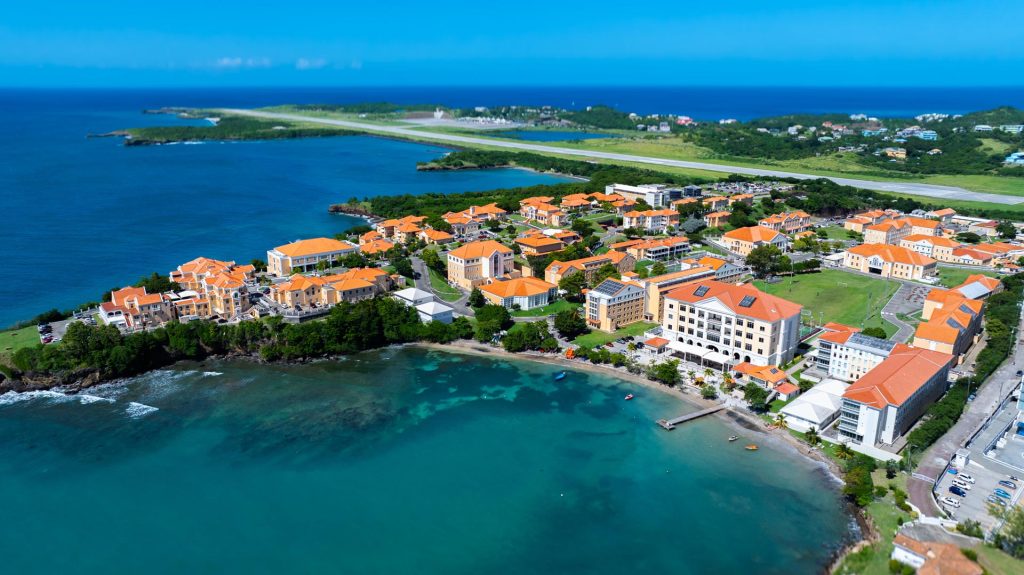
Imagine earning a globally accredited degree while studying in one of the world’s most beautiful, culturally rich regions. The Caribbean is rapidly emerging as a premier destination for higher education, offering internationally accredited degrees in fields such as medicine, business, engineering, and hospitality — at a fraction of the cost of universities in North America and Europe.
With its welcoming atmosphere, strong industry connections, and growing reputation for academic excellence, the region offers students an unparalleled blend of education and adventure. Whether you dream of studying at a top-tier medical school, immersing yourself in environmental research, or preparing for a career in the global marketplace, the Caribbean is the ideal destination.
A smart choice for global students
Caribbean universities offer a wise financial choice for global students. Tuition fees typically range from US$10,000 to US$15,000 per year, significantly lower than the US$25,000–US$60,000 charged annually by many universities in other parts of the world.
The Caribbean also generally offers a cost-effective lifestyle with lower utility, food, and transportation costs. Coupled with its proximity to North America and Europe, the Caribbean is a highly accessible study destination, boasting well-connected flight routes that offer affordable travel options. With English being the primary language of instruction at many institutions, English-speaking international students can seamlessly integrate
into academic life.
In addition to its affordability, the Caribbean is known for its rich cultural diversity and inclusive nature. Students from around the world come to study in a vibrant, multicultural environment, creating a unique learning experience. This rich cultural mix allows students to gain global perspectives, engage in cross-cultural exchange, and establish valuable international connections.
Training tomorrow’s doctors in the Caribbean
Many Caribbean medical schools are accredited by global bodies such as the World Health Organization (WHO) and the Caribbean Accreditation Authority for Education in Medicine & Other Health Professions (CAAM-HP). This accreditation ensures that their medical programmes meet international standards, allowing graduates to practise in many countries, including the United States, Canada, and the United Kingdom.
Dr Glen Jacobs, Provost of St George’s University (SGU), discusses the university’s transformative role in higher education: “[SGU] was founded 48 years ago to provide a new path for aspiring doctors to pursue their dream. Since then, the university has grown into a leading hub of medical and veterinary education. And with the addition of undergraduate and graduate programmes, it has greatly enhanced access to higher education in Grenada, the Caribbean region, and globally. We are proud of the more than 31,000 graduates of our four schools and to be the largest provider of actively licensed doctors in the United States, where more than 15,000 SGU graduates are licensed to practise medicine.”
SGU was founded to provide its students with a truly global education, a vision that remains steadfast today. “We have students and faculty hailing from more than 140 countries,” Dr Jacobs shares. “For our many students from abroad, the experience of coming to and living in Grenada, and studying together with students from so many different places and walks of life, is an essential part of an education that values intercultural exchange, mutual understanding, and humanistic compassion. We know these experiences equip our students for professional success wherever their passions and talents take them next.”
Texila American University (TAU) — situated in Georgetown, Guyana — attracts international students and offers opportunities for careers in global healthcare, with programmes that include a Doctor of Medicine (MD) degree. Other notable regional medical universities include Ross University School of Medicine in Barbados; the American University of the Caribbean School of Medicine (AUC) in Sint Maarten; and All Saints University School of Medicine in Dominica.
The UWI: advancing Caribbean education on the global stage
There are over 95 institutions of higher learning within the region. Of these, The University of the West Indies (UWI) has been a significant force in Caribbean development for over 75 years. With nearly 50,000 students, it has five campuses: Mona (Jamaica), St Augustine (Trinidad & Tobago), Cave Hill (Barbados), Five Islands (Antigua & Barbuda), and its Global Campus.
Professor Sir Hilary Beckles, Vice-Chancellor of The University of the West Indies, highlights UWI’s enduring legacy and its commitment to global development: “Building on a tradition of world-class education and our network of over 237,000 alumni — including Nobel Laureates and 25 heads of government/state — our regional university has worked strategically to ensure that our contribution to regional and global development is significant and enduring. Today, The UWI is proudly a global, activist, SDG-engaged University rooted in the Caribbean; this underpins our value to our students, prospective students and global partners.
“A leading source for information on Small Island Developing States and the Sustainable Development Goals (SDGs), The UWI spearheads a global university consortium on SDG 13 — Climate Action, bringing together universities across Latin America, Africa, Asia, Europe, and North America.
“Our institution is also the new Chair of the United Nations Academic Impact (UNAI) SDG Hub for SDG 13. Combined with our sustained, top ranking in the Times Higher Education University World Rankings & Impact Rankings since 2018, these reflect a strong commitment to the SDGs and research excellence.”
Education for the global workforce
The Caribbean offers specialised programmes in fields particularly relevant to the region, such as marine biology, environmental science, Caribbean studies, and tourism management. Students can participate in research opportunities that focus on unique regional issues, such as climate change, sustainable development, and biodiversity conservation.
As Sir Hilary notes, “Most recently, our unwavering commitment to the global good and quality education is exemplified in our newest International School for Development Justice. This UN endorsed, multi-accredited, online graduate school is the first-of-its-kind globally, as it exclusively supports the 17 UN SDGs. It innovatively integrates sustainability, social justice, and environmental responsibility with modern business practices.”
Trinidad & Tobago plays a pivotal role in this educational landscape, with The UWI St Augustine campus serving as a cornerstone of higher education. Along with institutions like the College of Science, Technology & Applied Arts of Trinidad & Tobago (COSTAATT) and The University of Trinidad & Tobago, it offers diverse, internationally recognised programmes. With its skilled workforce, strategic location, and extensive global partnerships, T&T attracts students across the Caribbean and beyond.
Graduating from a Caribbean institution opens doors to many global career prospects. Many regional universities have established partnerships with institutions across North America, Europe, Latin America, and beyond, facilitating student exchange programmes and research collaborations.
These connections provide students with access to international networking events, industry workshops, and real-world experience through internships with multinational companies. With a growing emphasis on academic-industry collaborations, students in the region are well-positioned to enter competitive global job markets and drive innovation in their respective fields.
Top five reasons to study in the Caribbean
- Caribbean universities offer various student support services, including orientation programmes, academic advising, and career counselling, making it easier for international students to adjust to life in the region
- Many institutions have dedicated international student offices to assist with visa processes, accommodation, and other logistical needs
- Caribbean nations have implemented supportive policies to attract international students, streamlining student visa procedures and reducing processing times and paperwork
- Several Caribbean countries have launched digital nomad visa programmes, with some extending eligibility to students
- Several universities offer post-graduation work permits or opportunities to stay and work in the region after completing their studies, providing a pathway to gaining international work experience.