
[ad_1]
Aquaculture — farming aquatic life — has a long history in the Caribbean. Last year, archaeologists operating in Belize published findings that showed Mayans guided fish through canals, putting them behind weirs or river barriers, where they were kept and used to feed tens of thousands of people, helping the ancient civilisation to develop.
Four thousand years later, Belize and the rest of CARICOM (the Caribbean Community) are struggling to keep up with other parts of the world where aquaculture contributes more than half of the seafood produced. For CARICOM, it accounts for six percent.
Aquaculture eases the problem of overfishing, which has caused fish stocks in the wild to be drastically depleted. It also helps to reduce the degradation of coral reefs, sea grass, and other parts of the marine environment caused by the encroachment of fishing vessels.
Aquaculture took off in Jamaica in the 1970s and was going well until around 2007, when things went downhill because of the global financial crisis and increasing competition.
Today, international, regional, national, and individual efforts are coming together to boost aquaculture in the region. The Caribbean Regional Fisheries Mechanism/CRFM, a CARICOM body, established the Aquaculture Working Group in 2014, developing a five-year action plan that has been updated and is being implemented to varying degrees by member countries.
“We are lagging behind the rest of the world in aquaculture development,” said CRFM’s then executive director, Milton Haughton, on a video posted late last year to mark the Caribbean Week of Agriculture. “We must therefore enhance our investments in aquaculture and support training and other capacity building programmes for farmers to improve their efficiency, reduce resource use, and mitigate climate risks.”
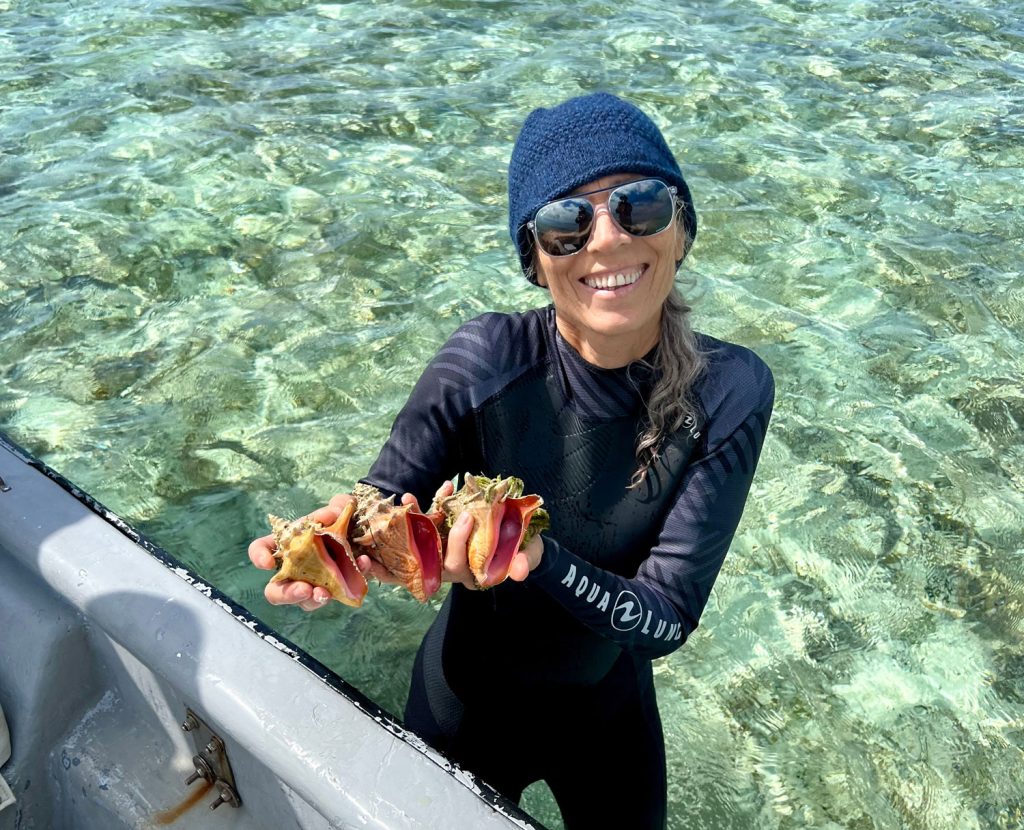
Megan Davis, the world’s foremost expert on queen conch — an iconic Caribbean marine species valued for its resplendent shell as well as its meat, and threatened by overfishing — has pledged to have a conch farm in every Caribbean nation.
She has been working with queen conch for over 45 years and, since 2019, she’s helped establish community-based conch hatcheries/nurseries in Puerto Rico, The Bahamas, Curaçao, and Jamaica. Predator-free, the hatcheries aim to grow conch by the thousands. They’re returned to the ocean when they’re about 7cm.
“If it wasn’t for aquaculture, there wouldn’t be enough seafood for people to eat,” Davis — a research professor at Florida Atlantic University’s Harbor Branch Oceanographic Institute — said in a Zoom interview.
“In the 1980s, there was a plateau that was reached,” she said of wild fish stocks. “And then aquaculture started to grow because populations started to grow in the world.”
Davis was part of a team that ran a conch farm when she lived in Turks & Caicos decades ago. No longer in operation, it was the first and remains the only commercial conch farm. Videos about the conch hatcheries on the Harbor Branch Institute’s YouTube channel show how challenging it is to rear conch.
Eggs are collected by fisherfolk in the community. Then the larvae and juvenile conch are cared for by highly trained staff using microscopes and other technical equipment. A video demonstrating how to feed the larvae — an intricate process — is half an hour long.
Making conch aquaculture commercially viable is under investigation, said Davis. Right now, her focus is on conservation of the species and providing a livelihood for the fisherfolk who depend on them.
“We don’t want there to be a day when there’s no more conch left in the ocean. The technology needs to stay alive. It needs to be taught to as many as possible,” she said.
Davis and her colleagues have designed a conch aquaculture manual and offer an online course that they call “eConch”. They also offer hands-on and virtual training at the hatcheries.
“One of the things we would like to see in the future is that there might be regional hatcheries,” said Davis. “So you start to have one place that has the very technical part of it. And then you have farmers and fishermen and the public or community members to be able to then take the little seedling conch, and they raise them in the tanks, and then more people can grow them.”
The Jamaican government earlier this year started construction on a massive tilapia hatchery at Twickenham Park, St Catherine, that when completed should generate five million tilapia fry a year to be made available to local farmers.
Raliegh Barnett, a Jamaican part-time fish farmer and YouTube content creator, praised the project but said his experience with state hatcheries is that they mainly benefit large-scale farmers more than small-scale farmers like him.
“The four times I’ve been there, they haven’t had the amount of fish (I wanted). Fish finish!” he said. “Because you’ll have one person coming in and purchasing, like, 6,000 fish. Another person purchasing 4,000 fish. You might have five to 10 persons coming in and buying off everything. So when the little man comes in for a five dozen or six dozen, they can’t get it.”
On his YouTube channel, Fish Keeping Jamaica, Barnett chronicles the highs and lows of rearing tilapia and ornamental fish. He has more subscribers, videos, and views than channels run by governments and NGOs about aquaculture in the Caribbean.
Aquaculture eases the problem of overfishing and helps to reduce the degradation of coral reefs, sea grass, and other parts of the marine environment
His wide, attractive smile and enthusiastic delivery could be part of the reason for his success. But it’s also because he’s providing information at a depth that isn’t found elsewhere.
“When I check on the internet, I actually see my own information coming up,” he said. “When I see ‘tilapia in Jamaica’, I see my videos come up, and so I realise that a lot of the academic information I’m sharing regarding tilapia has not been shared by anybody else.”
The government offers fish farming training. Barnett would like to get the certification that comes with the training. But going to a physical location doesn’t work for him and other people. “I have my 9-to-5,” said Barnett, a high school teacher.
Another challenge small-scale fish farmers face is expense. On a trip to New York last year, Barnett came across fish tank pumps at a far cheaper price than they are available in Jamaica. “Let’s say my light bill was $10,000,” he said. “After I installed the pumps and everything working, when I get my light bill the next month, my light bill jumped to 20-something thousand dollars!”
A more experienced fish farmer advised Barnett that he didn’t have to run the pumps all day and he was able to bring his electricity bill down to a more manageable amount. “It’s a little bit difficult for persons to finance the start up for a tilapia farm,” he said.
There’s strength and hope in numbers. The Caribbean Aquaculture Network came about when Juli-Anne Russo, a Jamaican aquaculture researcher and advocate, used the pandemic lockdown time to reach out to other people in the field from the region. The Caribbean Aquaculture Education & Innovation Hub is an online meeting place for the network.
Now with 180 members in 19 countries, the network has done a series of workshops and produces an online magazine. A YouTube channel features interviews and talks with farmers and researchers.
In an email exchange, Russo said a lack of education and research is one of the hindrances to aquaculture development in the Caribbean.
“There is a shortage of trained teachers and scientists, limited capacity-building initiatives, and uninformed policymakers. Policies hinder rather than support the sector’s growth,” she said.
She sees the meeting of minds in the hub as a hopeful sign.
[ad_2]
Source link